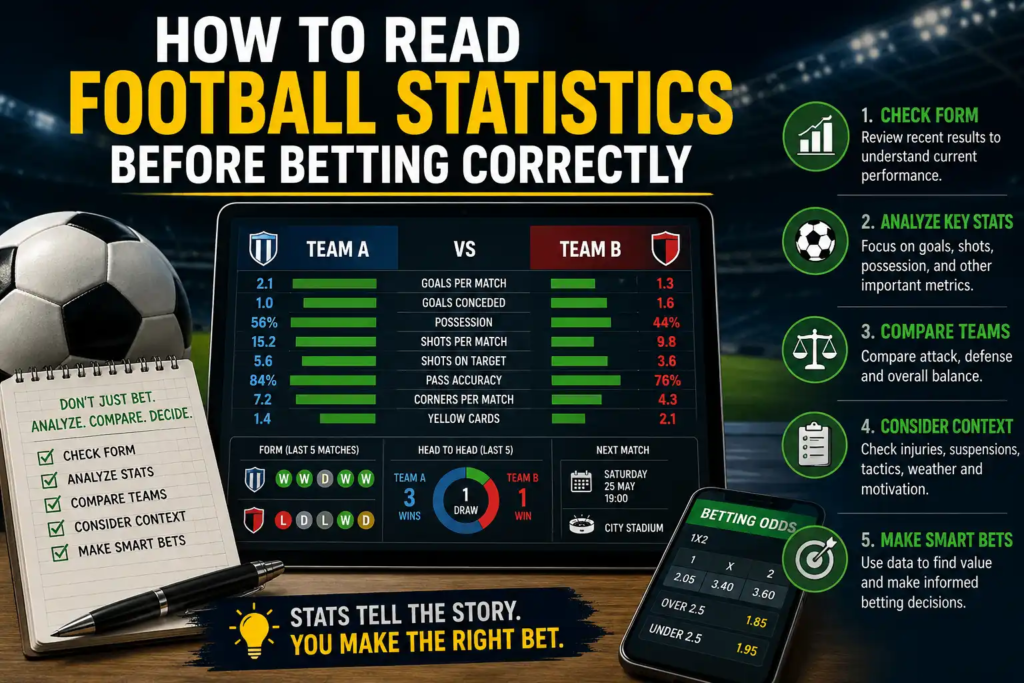
Football statistics guide showing how to analyze team form, key metrics, and match data for smarter betting decisions.
If you want to improve your football betting results, learning how to read football statistics before betting is essential. Many bettors place wagers based on emotions, favorite teams, or recent headlines. However, successful bettors rely on data and analysis to make informed decisions. Understanding football statistics can help you identify value bets, avoid common mistakes, and make more accurate predictions.
In this guide, you’ll learn how to read football statistics before betting, which numbers matter most, and how to use those statistics to improve your betting strategy.
Why Objective Data Matters in Sports Wagering
Football betting has become increasingly data-driven. Modern bettors have access to more information than ever before, including advanced metrics, team performance data, and player statistics. Evaluating matches objectively allows you to bypass guesswork. Statistics can reveal trends, strengths, weaknesses, and opportunities that many casual bettors overlook.
To capture these structural market benefits consistently, smart investors often cross-reference baseline data points with verified daily double football tips to capture pricing inefficiencies early.
How Statistics Improve Betting Decisions
Data metrics help answer important betting questions such as:
- Which team is in better form?
- Which team scores more goals?
- Which team performs better at home?
- Are both teams likely to score?
- Is the bookmaker’s price offering value?
The more accurately you can answer these questions, the better your overall betting selections become.
Common Analytical Errors to Avoid Before Betting
Many bettors misuse statistics by focusing on only one or two numbers. Football matches are influenced by multiple factors, and no single statistic tells the whole story.
Common mistakes include:
- Looking only at league position
- Ignoring recent form
- Overvaluing head-to-head records
- Ignoring injuries and suspensions
- Using very small sample sizes
Understanding these mistakes is a vital part of sharpening your overall match research.
How to Read Football Statistics Before Betting Correctly
Reading match data correctly means understanding which statistics matter most and how they work together dynamically to reveal genuine field value.
Evaluating Recent Form
Recent form is one of the first things bettors should analyze. Look at a team’s last five to ten matches and evaluate wins, draws, losses, goals scored, and goals conceded. A team on a strong run of form may have confidence and momentum, while a struggling side could continue to perform poorly. However, always consider the quality of the opposition. A winning streak against weak teams may not be as impressive as it appears.
Home and Away Splits
Home and away performance often plays a major role in match outcomes. Examine home/away win percentages, scoring volumes, clean sheets, and defensive concessions. Some teams are extremely strong at home but struggle away from their own stadium. Recognizing these structural disparities can help identify valuable betting opportunities.
Goals Scored and Conceded
Goals remain one of the most important indicators in sports betting. Analyze average goals scored and conceded per game along with clean sheet frequencies. Teams that consistently score goals while conceding regularly are often ideal candidates for premium goals markets. When learning how to read football statistics before betting successfully, tracking goal progression is a crucial fundamental element.
Advanced Metrics: How to Read Football Statistics Before Betting
Not all football statistics carry equal importance. Advanced data structures provide much deeper analytical insights into true team capabilities.
Expected Goals (xG)
Expected Goals (xG) measures the quality of chances a team creates. A team may score only once despite creating several excellent opportunities, while another team may score multiple goals from low-quality chances. Over time, xG often provides a more accurate picture of team performance than final results alone. For deep tactical drilling into global xG tables, referencing specialized statistical archives like FBref Football Statistics is highly recommended.
Both Teams to Score (BTTS)
If both teams regularly score and concede goals, BTTS betting may offer excellent value. When tracking historical BTTS percentages, home/away scoring trends can guide your slips perfectly. For a streamlined, premium approach to protecting your bankroll in these markets, backing your research with a verified single selections strategy keeps your risk balanced.
Over and Under Goal Trends
Useful goals statistics include over 2.5/3.5 percentages, match goal averages, and defensive shot concession frequencies. These numbers can help determine whether a specific fixture is likely to produce open play or a low-scoring stalemate.
Head-to-Head Context
Head-to-head records compare previous meetings between teams. Look for past goal averages, historical tactical matches, and historical clean sheets. While head-to-head data can provide useful context, it should never be the sole reason for placing a bet since squads change rapidly over seasons.
Shots on Target and Accuracy
Shots on target often reveal raw attacking strength better than goals alone. Track total shots per match, accuracy rates, and situational conversion rates. Teams consistently creating high shot volumes are more likely to score over the long term. Comprehensive, real-time match shot charts can be found on analytical dashboards like WhoScored Match Data.
Tailoring Statistics to Specific Markets
Different betting markets require completely different analytical approaches.
Match Winner Selections (1X2)
For standard match result betting, focus heavily on raw home/away performance splits, recent form variations, goal differences, and updated team news. Combining these elements provides a cleaner picture of each club’s true percentage chance to win. If you want to benchmark your calculated probabilities against vetted market winners, you can monitor the entries in our premium sure tips archive.
Over/Under Goals Strategies
Goals betting requires a tight focus on xG creation data, clean sheet vulnerabilities, and team historical totals. Fixtures involving highly active attacking teams with poor defensive records provide the strongest over betting positions.
Asian Handicap Analysis
Asian handicap betting requires a deep understanding of relative performance superiority. Focus your attention on clear winning margins, handicap cover rates, and historical goal distributions to see if a favorite is likely to clear their line.
Deeper Analytical Metrics
Modern sports analysis extends far beyond traditional win-loss columns.
Expected Assists (xA)
Expected Assists measure the quality of chances created by individual playmakers. Teams featuring high collective xA statistics create highly dangerous attacking opportunities and are frequently undervalued by bookmakers.
Possession Control
Possession statistics reveal how effectively teams control match tempo. Evaluate pass completion rates, final-third entries, and transition speeds. Possession data should always be paired with shot efficiency rather than viewed in isolation.
Defensive Stability
Strong defensive units often anchor highly profitable opportunities in under goals markets. Evaluate tackles won, team interceptions, structural block shapes, and clean sheet trends to spot defensive dominance early.
Critical Hazards in Football Data Analysis
Even highly experienced sports analysts can stumble if they misread performance metrics.
Misinterpreting Historical Data
Many bettors place too much emphasis on old matches. Football squads evolve quickly, and scorelines from several seasons ago carry virtually zero statistical relevance to a current fixture.
Overlooking Squad Rotations and Injuries
Pure numerical data cannot account for an unexpected training ground injury, a sudden suspension, or tactical squad rotation. Always double-check team lineups right before kickoff.
Relying on Tight Sample Sizes
One or two outlier matches do not build a trend. Always review a minimum sample size of five to ten recent matches to gather a reliable baseline for performance forecasting.
Maximizing Your Edge with Professional Analysis
Learning how to read football statistics before betting can significantly improve your betting strategy. Instead of relying on emotions or team reputation, statistics provide objective information that helps identify value and reduce risk.
By analyzing recent form, home and away performance, goals data, xG metrics, and team news, bettors can make more informed decisions. To benchmark your statistical conclusions against long-term historical trends, you can cross-examine your selections against the current entries inside our best betting choices vault to stay fully aligned with market performance.
Mastering football statistics takes time, but it is one of the most effective ways to become a smarter and more profitable football bettor.