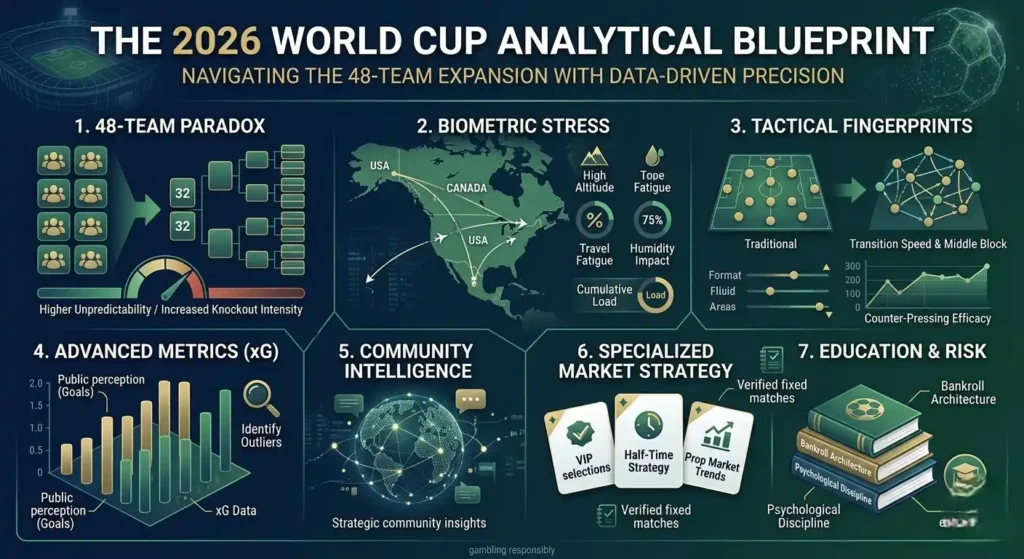
Visual data blueprint for the 2026 World Cup tournament. We model crucial, non-ball variables like Cumulative Biometric Load (travel fatigue between Mexico/USA/Canada), 48-team xG variance, and Prop Market Trends to find mathematical value in the tournament’s chaos.
The 2026 World Cup Analytical Blueprint: Navigating the 48-Team Expansion with Data-Driven Precision
The 2026 World Cup represents the most significant structural shift in the history of international football. With the expansion to 48 teams and matches spread across three nations (USA, Canada, and Mexico), the traditional methods of tournament forecasting are now obsolete. For the professional analyst, this isn’t just a tournament; it’s a massive data puzzle where the “edge” is found in the margins of travel fatigue, tactical fluidity, and xG variance.
1. The 48-Team Paradox: More Games, Higher Variance
The move from 32 to 48 teams introduces a level of unpredictability we haven’t seen in the modern era. The group stage now consists of The group stage now consists of 12 groups of four, where the top two teams and the eight best third-place finishers advance. This creates a 32-team knockout bracket, effectively doubling the number of elimination games.
From a data perspective, the group stage will likely feature more “Low Block” defensive setups. Underdog nations often prioritize defensive solidity to secure a point, which directly impacts the Total Goals market. While casual fans expect “more teams” to mean “more goals,” the reality of tournament football often leads to a more conservative tactical approach in the opening rounds.
2. Biometric Stress: The Travel and Altitude Variable
Unlike previous tournaments held in compact geographic areas, the 2026 edition spans an entire continent. A team might play their first match in the high altitude of Mexico City (2,200m) and their second in the humidity of Miami. World Cup 2026
In our professional modeling, we track “Cumulative Biometric Load.” Travel across four time zones and extreme climate shifts causes a measurable drop in high-intensity sprint volume. For instance, teams in Group A, like South Africa and Czechia, face grueling itineraries exceeding 4,000km, while host Mexico enjoys a “VIP schedule” with matches concentrated in their home territory. When analyzing upcoming matches, the team with the more efficient travel schedule often holds a 3%–5% statistical advantage that the market fails to price correctly.
3. Tactical Fingerprints of the Modern Game
The 2026 tournament will be defined by Transition Speed. In the current tactical climate, the “Middle Block” has become the preferred defensive posture for elite sides. We are seeing teams move away from heavy possession in favor of “Rest-Defense” and rapid counter-pressing.
By analyzing tactical transition speeds, we can identify which teams are most likely to exploit the spaces left by aggressive, possession-heavy opponents. This is where professional data becomes invaluable—moving beyond the scoreboard to understand the structural integrity of a team’s formation. For those looking for consistent results in these high-variance environments, we recommend following our verified daily double football tips which are built on these exact mathematical principles.
4. Advanced Metrics: Moving Beyond the Final Score
To succeed in the 2026 market, one must look at Expected Goals (xG) and Expected Threat (xT). A scoreline of 1-0 rarely tells the whole story. If a team creates 2.8 xG but fails to convert, the public sees a “weak” attack, while the data shows a high-performing unit due for a positive regression to the mean.
Our analysis focuses on these outliers. By identifying teams that are under-performing their metrics, we find value before the general market catches on. This data-driven approach is the backbone of our premium services, including our single fixed matches and high-conviction sure fixed matches selections.
5. Market Psychology and “Outcome Independence”
One of the biggest hurdles in tournament analysis is emotional bias. Fans often back “big names” based on historical reputation rather than current 2026 form. Professional forecasting requires Outcome Independence—the ability to stick to a proven model regardless of short-term variance.
The World Cup is a marathon of 104 matches. Success isn’t found in a single “lucky” result, but in the disciplined application of a risk-management strategy over the course of the entire summer. We apply this same level of discipline to our best fixed matches, ensuring that every selection is backed by statistical probability rather than fan sentiment.
6. The Opening Match: Mexico vs. South Africa (June 11, 2026)
The tournament kicks off at the renovated Estadio Azteca. This match is a tactical masterclass in home-field advantage vs. physical endurance. Mexico, led by Javier Aguirre, faces a South African side that is typically fast and highly motivated.
However, the “Azteca factor”—the 2,200m altitude and the thin air—acts as a 12th man for Mexico. Data shows that opponents’ stamina drops significantly after the 60th minute in Mexico City. Analyzing how South Africa manages their “High-Intensity Bursts” in the first half will be key to identifying live betting opportunities.
7. The Rise of Prop Markets in 2026
With the expansion of data availability, we are seeing a massive surge in Prop Betting. Markets for player-specific shots on target, card counts, and corner frequencies offer more “pockets of value” than the traditional 1X2 market. Analyzing these “non-ball” variables, such as referee tendencies in high-stakes knockout rounds, is a core component of our tournament strategy.
8. Education: The Ultimate Edge
The most important tool in your kit isn’t a tip—it’s knowledge. Understanding how to manage a bankroll during a 39-day tournament is what separates the professionals from the casuals. We have developed a comprehensive Betting Education hub specifically to teach the psychological discipline and mathematical foundations required for 2026.
This hub covers everything from understanding Kelly Criterion staking to the nuances of “Draw No Bet” strategies in knockout football. By educating our community, we ensure that you are equipped to handle the market volatility that inevitably comes with a 104-match tournament.
9. Strategic Entry Points and VIP Insights
Because of the sheer volume of matches in 2026, we have categorized our analysis to help users focus on high-conviction opportunities:
The VIP Selection: Matches where biometric data, tactical mismatches, and market value align perfectly.
Half-Time Strategy: International football is often a “game of two halves.” Tactical adjustments at the 45-minute mark can completely change a match’s trajectory.
Transparency: In an industry filled with empty promises, we believe in full accountability. Every model we run is tracked to ensure long-term reliability.
10. Conclusion: The Future of Football Analysis
The 2026 World Cup will be a defining moment for sports analytics. As the game becomes more complex, the gap between the “casual observer” and the “professional analyst” will continue to widen. By focusing on raw data, tactical principles, and institutional-grade risk management, we can navigate the chaos of the 48-team expansion with confidence.
Please gamble responsibly.