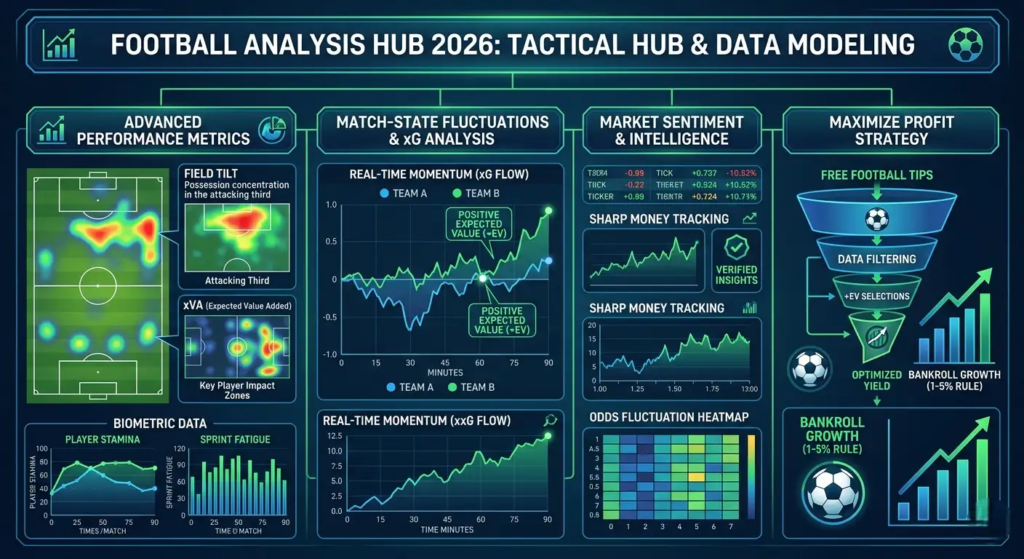
An integrated analytical dashboard designed for the Football Analysis Hub 2026, combining cutting-edge data modeling, heatmaps, xG analysis, and market intelligence to define a professional edge.
Football Analysis Hub 2026: The Definitive Guide to Modern Betting Intelligence
The landscape of football analysis has undergone a seismic shift as we head through the 2026 season. Gone are the days when a quick look at the league table and a team’s “motivation” was enough to find an edge. Today, the Football Analysis Hub serves as the central nervous system for bettors who treat the market as an investment rather than a game of chance.
To win in 2026, you must master the intersection of tactical shifts, biometric data, and mathematical market inefficiencies. This guide breaks down the core pillars of professional-grade analysis.
1. Tactical Evolution: The Era of “Functional Versatility.”
In 2026, the rigid formations of the past (like the traditional 4-4-2) have been replaced by “game-state” fluidity. Top-tier teams now prioritize players who can occupy three different positions within a single 90-minute window.
The Hybrid Full-Back: Analysis now focuses heavily on defenders who tuck into the midfield during possession. This creates a “box midfield” that overwhelms opponents in central areas.
High-Line Vulnerability: We track the distance between a team’s goalkeeper and their last defender. Teams playing a “suicidal” high line are prime targets for “Draw No Bet” or “Over 2.5 Goals” markets when facing opponents with elite transition speed.
The Pressing Trigger: Professional analysis involves identifying which specific player triggers the team’s press. If that player is substituted or injured, the team’s defensive integrity often drops by 15–20% in real-time.
2. Advanced Metrics: Beyond xG
While Expected Goals (xG) is now common knowledge, the Football Analysis Hub 2026 looks at the “Second Generation” of data points to find value before the bookmakers adjust their lines.
xVA (Expected Value Added)
This metric measures how much a player increases their team’s probability of scoring simply by their positioning and passing, even if they don’t get the assist.
Post-Shot xG (PSxG)
For those betting on “Both Teams to Score” or “Clean Sheet” markets, PSxG is vital. It evaluates the quality of the shot after it has been taken, accounting for shot placement. This helps identify goalkeepers who are over-performing or under-performing their statistical baseline.
Field Tilt
Field tilt measures a team’s share of possession exclusively in the final third. A team might have 60% possession, but if their field tilt is only 40%, they are passing pointlessly in their own half. We look for teams with high field tilt but low recent goal tallies—these are “due” for a breakout win.
3. The 2026 Market Architecture: Finding the Edge
Maximizing profits requires moving beyond the “1X2” market and exploring specific high-conviction tiers. At our hub, we categorize opportunities based on their mathematical “Confidence Score.”
Verified High-Confidence Plays: For the most rigorous data-backed selections, professionals turn to sure fixed matches and best fixed matches. These represent the pinnacle of our analytical funnel.
Volume-Based Growth: If you prefer consistent daily action to build your bankroll, focusing on daily double football tips or single fixed matches allows for steady compounding of your capital.
4. Biometrics and Logistics: The “Hidden” Factors
In a world where everyone has access to the same scores, the Football Analysis Hub gains an advantage by looking at the factors that don’t appear in a box score.
Travel Fatigue: With the expansion of international tournaments, travel schedules are more grueling than ever. We track “Air Miles per Week” for key squads. A team flying across time zones for a Tuesday night match is statistically 12% more likely to concede in the final 15 minutes.
Squad Rotation Modeling: By analyzing “Load Management” data, we can often predict a manager’s starting XI before the official team sheets are released. Catching the market before the odds drop due to a star player being rested is a key profit driver.
5. Psychological Resilience and “Tilt” Management
Even the best analysis fails if the bettor cannot manage their own psychology. “Tilt” is the greatest enemy of profit.
The 2% Rule: Never let a single match dictate your emotional state. By keeping stakes to a flat 2% of your bankroll, you ensure that a “bad beat” in the 90th minute is merely a data point, not a disaster.
The Blackout Protocol: If you suffer three consecutive losses, our protocol suggests a 48-hour “Blackout”—no bets, no checking scores. This resets your analytical brain and prevents “revenge betting.”
6. External Resources and Community Verification
No analyst is an island. To maintain a 360-degree view of the market, we cross-reference our internal data with global leaders in sports intelligence:
Tactical Deep Dives: For heatmaps and individual player performance scores that feed into our models, we utilize the comprehensive database at WhoScored.
Global Market Movements: Tracking how “Sharp Money” moves in Asian and European markets is essential. We monitor real-time fluctuations via OddsPortal to ensure our tips still hold value at the time of publication.
Responsible Engagement: The goal of the Football Analysis Hub is long-term, sustainable success. We advocate for disciplined, informed play. If you ever feel your betting is becoming a burden rather than a strategy, please consult the resources at BeGambleAware.org.
7. Conclusion: The Hub Advantage
The Football Analysis Hub 2026 is more than just a collection of tips; it is a commitment to a professional methodology. By combining advanced xG metrics, biometric tracking, and disciplined bankroll management, you move from the world of “gambling” into the world of “probability-based investing.”
Stay focused on the data, ignore the media noise, and let the numbers drive your success.